Irlandya: A Modern Handwritten Font That Feels Like Your Handmade Touch
There’s a quiet magic in the moment you type “Lavender & Sage” into your design software and watch it bloom across the screen in Irlandya. I was tweaking candle labels one rainy Tuesday—testing how the font wrapped around a circular sticker, checking spacing on a kraft paper tag—and suddenly, everything felt *right*. Not perfect, not sterile—but warm, intentional, full of breath. That’s Irlandya: a modern handwritten font with brushstroke energy, soft contrast, and just enough rhythm to feel human without sacrificing clarity.
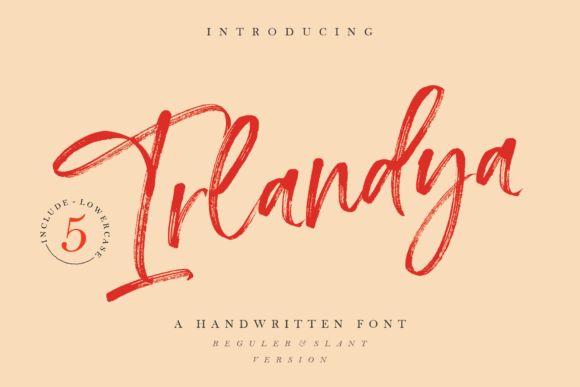
It’s not the kind of script that drowns in flourishes or demands center-stage drama. Instead, Irlandya moves with gentle confidence—slightly upright, subtly connected, with natural entry and exit strokes that echo real pen-on-paper motion. The lowercase ‘a’, ‘g’, and ‘y’ have that friendly, approachable tilt; capitals carry presence but never stiffness. It’s a Script Handwritten typeface built for makers who want elegance *with* ease—no overworking, no second-guessing whether it’ll cut cleanly on a Cricut or hold up at 8pt on a tea towel tag.
I’ve used Irlandya across real projects this season: hand-poured soy candle labels (printed on matte sticker paper), seasonal greeting cards (paired with a light sans serif for body text), wedding invitation suites (where it shines as names and headings), and printable wall art for small-batch digital shops. On planner pages, it adds personality to section headers without competing with functional layouts. On boutique packaging—think cotton drawstring bags or folded gift boxes—it elevates the unboxing experience before the product is even touched. Even on mugs and tote bags, where ink coverage and curve distortion can betray weaker scripts, Irlandya holds its shape beautifully thanks to balanced letter proportions and open counters.
What makes it especially practical is how thoughtfully it balances display impact with everyday usability. Yes, it’s a premium font designed for titles, logos, and decorative phrases—but unlike some delicate script fonts, Irlandya remains legible at smaller sizes. I tested it down to 10pt on printed thank-you cards and 9pt on mini gift tags (3×2 inches), and it stayed clear and inviting. For cutting machines, I found the standard OTF version cuts smoothly at 12pt and above—just avoid ultra-thin swashes if you’re working with fine vinyl or intricate die-cut shapes. Always check your file format: Irlandya typically includes OpenType features like ligatures and stylistic alternates, which add subtle polish when enabled in design apps like Illustrator or Affinity Designer.
Font pairing? Think harmony, not contrast overload. I often pair Irlandya with a clean, neutral sans serif—like Montserrat Light or Inter—for body copy, pricing, or ingredient lists. It creates visual hierarchy without tension. For wedding stationery or vintage-inspired prints, a simple serif like Lora or Playfair Display works elegantly alongside it. And while mixing two scripts can be tricky, Irlandya plays well with a quieter, more restrained handwritten companion—say, for handwritten-style accents or callout quotes—because its baseline rhythm stays grounded.
Real-world use means paying attention to what’s included. Before adding Irlandya to your shop files or physical products, double-check the license: most versions include commercial use rights, but verify whether it covers merchandise, digital templates, SVG bundles, or resale of pre-designed assets. Also confirm file formats—OTF is ideal for design flexibility; TTF works well for basic desktop use; web fonts may be needed if you’re embedding in digital shop banners or email newsletters. If your audience includes multilingual buyers, glance at character support: Irlandya usually covers Latin-based languages thoroughly, including accented characters common in French, Spanish, and German—handy for international craft fairs or Etsy listings.
One of my favorite moments was designing a set of printable holiday tags. I typed “For You, With Love” in Irlandya, scaled it to fit a scalloped oval, then printed a test batch on textured cardstock. The slight texture caught the ink just right—emphasizing the brush-like weight shifts, making each tag feel individually made, even though they were digital. Customers don’t see the font name—but they *feel* the care in the curve of the ‘r’, the soft landing of the ‘e’. That emotional resonance? That’s Irlandya doing quiet, consistent work for your brand identity.
It’s also become my go-to for social media graphics—especially Instagram carousel slides announcing new collections or seasonal launches. Because Irlandya reads well even in compressed preview thumbnails, and because its rhythm guides the eye naturally from headline to call-to-action, it helps maintain cohesion across platforms without needing heavy filters or overlays. In editorial design for printable planners or habit trackers, it adds warmth to weekly headers while letting grids and checkboxes stay crisp and functional.
Whether you're laser-cutting wooden signs, printing on recycled kraft tags, laying out digital downloads, or prepping SVG files for Silhouette users, Irlandya adapts—not by being generic, but by being *thoughtful*. It doesn’t shout. It invites. It complements handmade textures, natural materials, and intentional minimalism. And because it’s a modern handwritten font—not nostalgic, not overly formal, not trend-chasing—it fits seamlessly into evolving shop aesthetics, from farmhouse charm to quiet luxury to joyful maximalism.
If you’re choosing a typeface to represent your craft, think beyond “pretty.” Ask: Does it reflect how your hands move when you write? Does it scale across stickers, screens, and signage without losing soul? Does it leave room for your voice—and your customer’s imagination—to settle in? With Irlandya, the answer keeps coming back: yes.